Creatine beyond the gym: what the research says about memory and aging
What randomized trials and pooled reviews have found about creatine for memory, muscle, bone, and function in older adults, and how strong that evidence is.
 By Dr. Daniel Ashford, DOPhysical Medicine & RehabilitationMarch 13, 20266 min read



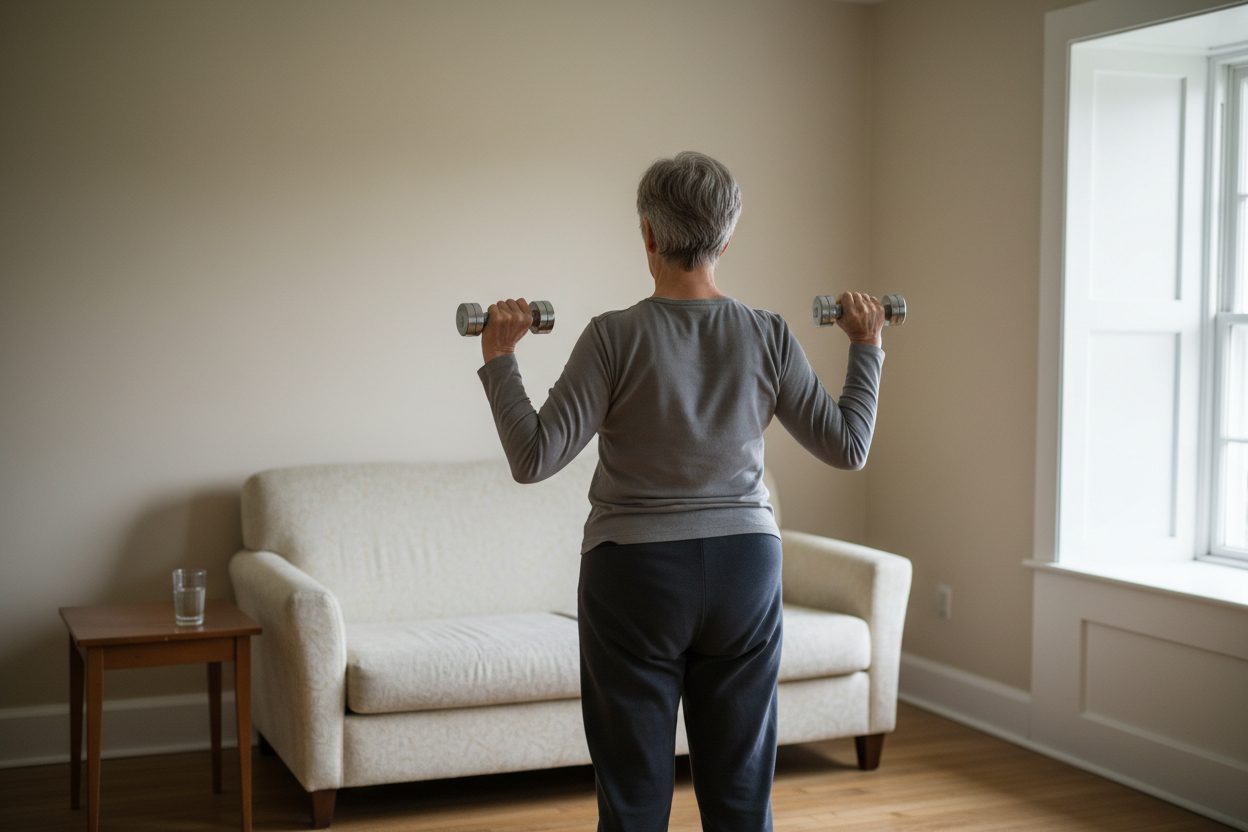
Creatine is best known as a supplement for people who lift weights. It is also one of the compounds the brain uses to keep its energy supply steady, and over the past two decades researchers have asked whether taking it could help memory, especially in older adults. The short answer from the randomized trials is that there may be a small benefit to memory, that the benefit looks larger in older people and in people under physical stress, and that the trials behind this are small, short, and not fully consistent with one another.
The evidence for creatine in aging muscle is on firmer ground. Pooled trials show that older adults who take creatine while doing resistance training gain more lean mass and somewhat more strength than those who train with a placebo. For bone, the one long trial found no effect on bone density. At the doses used in these studies, creatine has a long safety record in healthy people.
This article is for adults in middle age or older who have heard that creatine does something for the brain and want to know what the studies measured, how big the effects were, and where the evidence stops.
Why creatine is being studied for the brain
Creatine is made in the body and eaten in meat and fish. Cells store it as phosphocreatine and use it to regenerate ATP, the molecule that powers most cellular work, during bursts of demand. Muscle holds most of the body's creatine, but the brain holds some too, and taking creatine orally raises brain creatine levels by a measurable amount. The idea behind the cognitive research is that a larger energy buffer might help brain cells during demanding tasks, during sleep loss, or as energy metabolism declines with age. That is a plausible mechanism, not a demonstrated one, and the trials described below are the test of it.
What the memory trials found when pooled
Two meta-analyses have combined the randomized trials. Prokopidis et al., 2023 identified 10 placebo-controlled trials of creatine and memory in healthy people and pooled 8 of them. Overall, creatine improved memory scores by a small amount, a standardized mean difference of 0.29. The effect was concentrated in older adults aged 66 to 76, where the difference was 0.88, while in participants aged 11 to 31 it was close to zero. Dose, which ranged from about 2 to 20 grams a day, and trial length, from 5 days to 24 weeks, did not change the result. A published letter, 2023 argued that the analysis double-counted some data by entering several outcomes from the same trial as if they were independent, which would make the result look more certain than it is. Readers should treat the pooled estimate as rough.
A broader review by Xu et al., 2024 pooled 16 trials with 492 participants aged from about 21 to 76, including some with medical conditions. Creatine improved memory by a similar margin, a standardized mean difference of 0.31, and the authors rated that evidence as moderate certainty. Effects on attention and processing speed were smaller and rated low certainty, and there was no effect on overall cognitive scores or on executive function. In subgroup analyses the benefit looked larger in people with illnesses, in those aged 18 to 60, and in women, which does not line up neatly with the older-adult finding from the first review. When trials are this small, subgroup results move around a lot, and the honest reading is that the memory signal is real but modest and the details are not settled.
The largest single trial
The biggest trial to date was designed to resolve some of this. Sandkühler et al., 2023 gave 123 adults 5 grams of creatine a day for six weeks and a placebo for six weeks, in random order, and tested them on a reasoning test, a working memory test, and eight other cognitive tasks. The working memory result just missed statistical significance, the reasoning test showed nothing, and none of the eight other tasks improved. A Bayesian analysis supported a small benefit. Side effects were reported about four times as often on creatine as on placebo. Half the participants were vegetarians, who have lower creatine stores and were expected to respond more, but they did not. The authors concluded that creatine might have a small effect on cognition and that larger trials are needed to confirm or rule it out.
An early look in Alzheimer's disease
The trials above enrolled healthy people. In 2025 a research team reported the first clinical study in people with Alzheimer's disease. Smith et al., 2025 gave 20 patients 20 grams of creatine a day for eight weeks. Brain creatine measured by spectroscopy rose by 11 percent, and scores improved on a global cognitive composite and several individual tests. This was a single-arm feasibility study with no placebo group, so practice effects and expectation cannot be separated from any drug effect. It shows that the approach is tolerable and that creatine reaches the brain in this population. It does not show that creatine helps Alzheimer's disease, and the authors say so.
Muscle, walking speed, and bone in older adults
The research on creatine and aging muscle is larger and more consistent. Chilibeck et al., 2017 pooled 22 randomized trials with 721 participants with mean ages from 57 to 70 who did resistance training two or three times a week for 7 to 52 weeks. Those taking creatine gained 1.37 kilograms more lean tissue than those on placebo, and had modestly larger gains in chest press and leg press strength. That analysis covered only creatine taken alongside training, so it does not say what creatine does on its own.
The longest trial looked at bone. Chilibeck et al., 2023 randomized 237 postmenopausal women, average age 59, to creatine at 0.14 grams per kilogram of body weight a day or placebo while they followed a program of resistance training three days a week and walking six days a week for two years. Bone mineral density at the hip, femoral neck, and spine declined by similar small amounts in both groups. Creatine did preserve some measures of the geometry of the upper femur that predict bending strength, and the creatine group walked 80 meters about one and a half seconds faster at two years while the placebo group did not change. Strength gains were the same in both groups. The main result, no effect on bone density, is a reminder that promising mechanisms do not always produce the outcome that matters.
Dose, safety, and who should be careful
Most trials use 3 to 5 grams of creatine monohydrate a day, sometimes after a short loading period at higher doses. The International Society of Sports Nutrition position stand, 2017 states that short and long-term supplementation, including doses up to 30 grams a day for five years, has been safe and well tolerated in healthy people and in a range of patient groups. The side effects most often discussed are water retention and stomach upset, and the 2023 trial above found that side effects of some kind were more frequent on creatine than on placebo. Many authors in this field have ties to creatine manufacturers, and the position stand discloses this, which is one reason to weigh the independent trials more heavily.
People with kidney disease, people taking medicines that affect the kidneys, and anyone pregnant should talk to their doctor before using creatine, because these groups were generally excluded from the trials. Older adults considering it for memory should know that the expected effect, if it exists, is small, and that the stronger evidence is for muscle gained alongside resistance training.
Sources
- Effects of creatine supplementation on memory in healthy individuals: a systematic review and meta-analysis of randomized controlled trials (Prokopidis et al., Nutrition Reviews, 2023) — systematic review of 10 randomized trials, 8 pooled, with subgroup analysis by age
- Letter to the Editor: Double-counting due to inadequate statistics leads to false-positive findings (Eckert and Pascher, Nutrition Reviews, 2023) — published critique of the statistical method in the Prokopidis meta-analysis
- The effects of creatine supplementation on cognitive function in adults: a systematic review and meta-analysis (Xu et al., Frontiers in Nutrition, 2024) — meta-analysis of 16 randomized trials, 492 participants, GRADE-rated evidence
- The effects of creatine supplementation on cognitive performance: a randomised controlled study (Sandkühler et al., BMC Medicine, 2023) — preregistered randomized crossover trial, n=123, 5 grams a day for 6 weeks vs placebo
- Creatine monohydrate pilot in Alzheimer's: Feasibility, brain creatine, and cognition (Smith et al., Alzheimer's and Dementia: Translational Research and Clinical Interventions, 2025) — single-arm pilot, 20 patients with Alzheimer's disease, 20 grams a day for 8 weeks, no placebo group
- Effect of creatine supplementation during resistance training on lean tissue mass and muscular strength in older adults: a meta-analysis (Chilibeck et al., Open Access Journal of Sports Medicine, 2017) — meta-analysis of 22 randomized trials, 721 older adults, 7 to 52 weeks
- A 2-yr Randomized Controlled Trial on Creatine Supplementation during Exercise for Postmenopausal Bone Health (Chilibeck et al., Medicine and Science in Sports and Exercise, 2023) — randomized trial, 237 postmenopausal women, 2 years, creatine vs placebo during resistance training and walking
- International Society of Sports Nutrition position stand: safety and efficacy of creatine supplementation in exercise, sport, and medicine (Kreider et al., Journal of the International Society of Sports Nutrition, 2017) — position statement reviewing safety and dosing evidence; authors disclose industry ties
This article is for general information and is not medical advice. Talk to your doctor before changing a medication, treatment or exercise program.